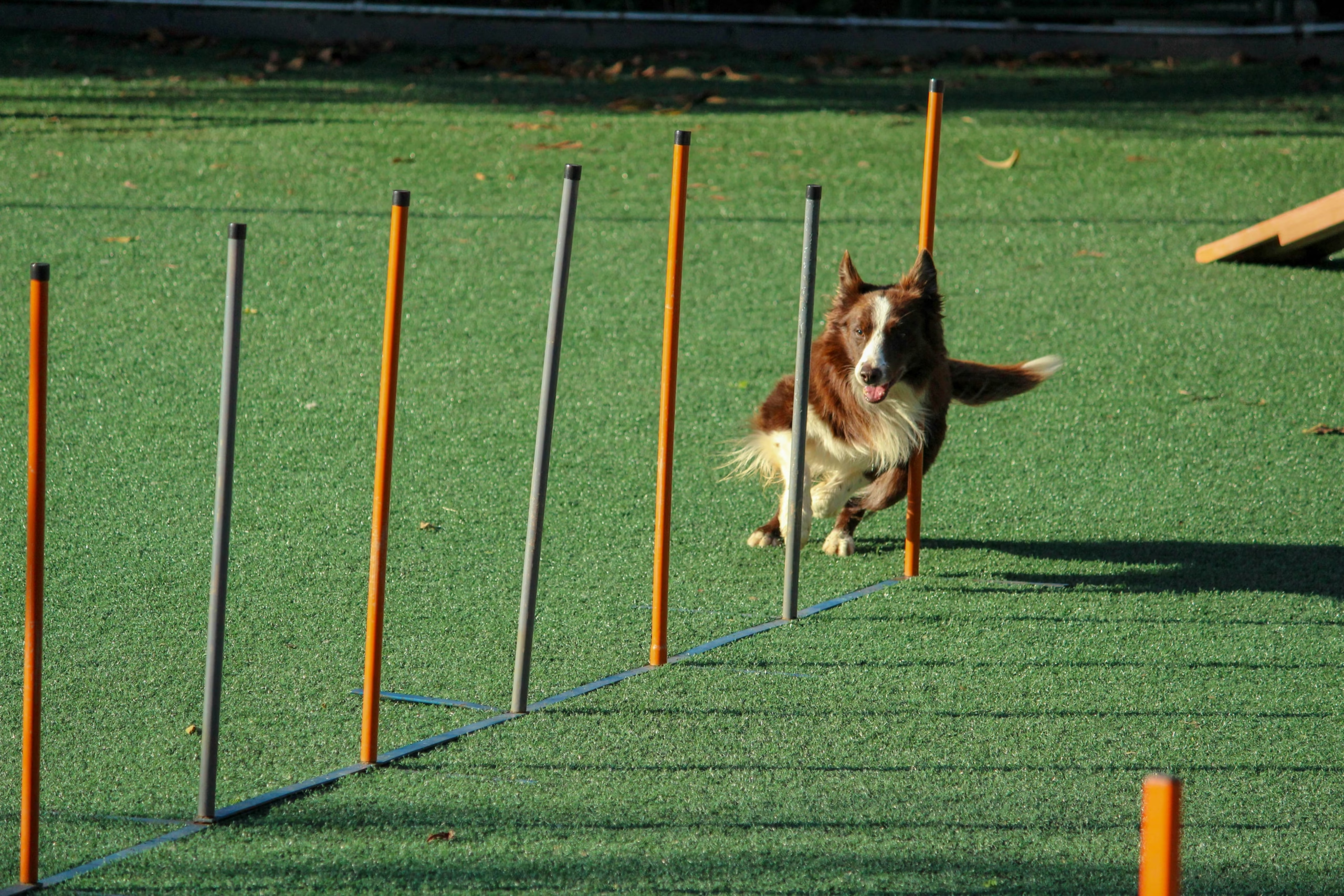
If preparing your dog feels more like climbing a mountain, there are plenty of solutions. If you have a boisterous puppy or an old dog who is stuck in his ways, the correct dog training hacks can revolutionize the way that you train your pooch. These are not fancy, high-falutin’ tricks that take years of expertise — they’re simple, practical approaches which work in real life.
Basic commands, barking issues and leash pulling are common problems for many dog owners. The good news? You don’t need costly classes or fancy equipment. These 10 never before revealed dog training hacks will help you finally achieve faster results and have an amply satisfying relationship with your furry friend!
Now, let’s get into some of the methods that trainers swear by and dog owners can’t get enough of.
The Reason Why Traditional Training Techniques Do Not Work Period
Before we delve into hacks, it’s worth taking a moment to pinpoint why certain training methods fail. A lot of folks try to “train” their dogs with shouting and punishment. This fosters fear and trepidation, not knowledge.
Dogs respond best to positive reinforcement. It means rewarding good instead of punishing bad. Your dog will be motivated to do those behaviors again when you emphasize the goodness of what they’re doing right.
Another common mistake? Inconsistency. One day if you let your dog up on the couch and then scold them the next, they’re going to be confused. Clear boundaries and a common response is essential for reliable dog training.
Hack #1: High-Value Treats To The Rescue
All treats were not created equal in your dog’s eyes. Regular kibble may be okay in a pinch, but high-value treats are pure magic during training.
“High-value” treats are uncommon foods that your dog GOES CRAZY over. Picture small chunks of chicken, cheese, hot dogs or freeze-dried liver. He doesn’t get to eat these all the time, they’re jackpots.
How to use this hack:
Reserve these treats for training only. When your dog sits on command, reward him with something he’d jump through hoops for. This provides a pretty good incentive for listening to and carrying out instructions.
Keep them small — pea-sized. You will want to train often without overfeeding your dog. Small portions equate to greater repetitions and faster learning.
Switch up your rewards occasionally. If your dog gets the same treat every time it’s no longer special. The variety creates a guessing game and it keeps an audience in suspense.
Hack #2: The Golden Timing Rule of Two-Seconds
Timing is everything with dog training. Too late and your dog will not associate the treat with the behavior you are looking for.
The two-second rule is easy-peasy: Reward your dog within two seconds of them doing the right thing. Any longer, and they might think you’re rewarding something completely different.
Why this works:
Dogs live in the moment. They do not contemplate the past or future in human terms. But when you do it right away, their brain can see a direct cause and effect: “I did this thing, and something awesome happened.”
Use a marker word like “yes!” or clicking as soon as your dog does the behavior correctly. Then reward with the treat within two seconds. This combination creates crystal-clear communication.
Work on that kind of timing with an easy cue such as “sit” or “down.” The sooner you are at marking and rewarding, the faster your dog will learn.
Hack #3: Small Training Bites Prevail Every Time
You and your dog are worn out! Practice in short bursts of time throughout the day, rather than long marathons.
Five to 10 minutes is just right. Your dog remains engaged, you remain patient, and learning actually sticks better.
Here’s the schedule that works:
- Morning session: 5-10 minutes prior to breakfast
- Afternoon session: 5-10 minutes during playtime
- Evening Session: 5-10 minutes prior to dinner
Three brief workouts trump one 30-minute blast every time. Your dog’s brain absorbs information better with breaks.
Conclude each session on a high note. Stop there if your dog performs the command successfully. You want them to leave feeling they’ve been successful and building excitement for the next time.
Hack #4: Real Life Rewards That Are Not Food-based
Treats are always wonderful, but they are not the only reward your dog values. The best dog trainers leverage what their dog’s motivation.
Does your dog go nuts for a tennis ball? That’s a reward. Do they love belly rubs? That’s a reward too. Backyard access, a favorite toy or even a sniff walk can be good-behavior motivators.
The Premack Principle in action:
This is called the Premack principle, and it dictates that you can use one activity your dog likes to do as a reward for doing something else that you want him to do. For example:
- Your dog wants to go outside. Sit them down first, then open the door.
- Your dog wants their dinner. Have them lie first, before you put the bowl down.
- Your dog wants to say hello to another dog. Now make them walk nicely first, before permitting the greeting.
This hack transforms those everyday moments into training sessions. You’re not imposing any extra work — you’re merely setting a straightforward condition that needs to be met before your dog can receive what they already want.
Hack #5: The Name Game for Better Concentration
A lot of dogs won’t even listen, because that learned cue (their name) doesn’t mean anything to them. Fix this with the name game.
How to play:
Say your dog’s name one time in a cheerful voice. As soon as they glance at you, cue it (“yes!”) and give a treat. That’s it.
Repeat this 10 times in a row, several times a day. Next thing you know, your dog will whip its head around every time it hears its name being called.
This provides the basis for all other commands. Before you can teach “come” or “stay,” your dog has to check in with you. The name game further fuels that all-important attention.
Never punish your dog with your dog’s name. If you scream their name when mad, they’ll learn to run in the other direction when called. Keep it positive always.
Hack #6: Nothing In Life Is Free Magic
This protocol may sound tough, but it’s remarkably effective and builds your relationship too.
The idea: Your dog gets anything he wants because you asked him to do something first. And I don’t mean be mean — I mean have reasonable communication, respect.
Examples in daily life:
- Before feeding: Ask for a sit or down
- Before going outside: Ask for a calm wait at the door
- Before engaging in petting: Request eye contact or a sit
- Before playing with toys: Engage with a basic trick
This hack casts you as the provider of wonderful things. Your dog figures out that cooperation brings reward. Plus, you’re practicing the commands many dozens of times a day without even doing formal training sessions.
Dogs actually love this structure. It provides them with clarity about what you want and the right way to get what they want.
Hack #7: Reward Good Behavior Randomly
Wise owners click for good behavior when it occurs spontaneously.
For instance, maybe your dog goes and lies down calmly while you watch TV. Give them the treat and praise suddenly. That was not something they were expecting, so that’s even more powerful.
Why random rewards work better:
Psychologists refer to this as a variable reward schedule. It operates on the same principle as a slot machine. When rewards are delivered unpredictably, behavior is strengthened and more resistant to extinction.
If you reward every single sit, your dog might sit only when treats are in sight. But if you reward randomly — or sometimes with treats but sometimes with praise, or even nothing at all — your dog will keep trying because she never knows when the jackpot might hit.
Find three good things to catch your dog doing every day. Lying quietly, chewing on their own toy, or sitting politely — all could have gotten a pat on the head.
Hack #8: The Magic of Crate Training the Right Way
Crates are cruel, many people say, but dogs are den animals by nature. When correctly introduced, the crate is their happy place and solves many issues simultaneously.
Crate training can keep your dog out of trouble when you’re away at work, housebreaking is often easier with a crate, and your dog always has a place to go when they are feeling stressed.
Proper Crate Introduction:
Never force your dog inside. Begin by making the crate an irresistible place to hang out. Throw treats in it, feed meals in there and keep the door open.
Allow your dog to investigate in their own time. Once they’re going in willingly, begin shutting the door for just a few seconds while you stay nearby. Gradually increase the time.
The crate must be large enough for your dog to stand, turn around, and lie down comfortably. Throw in a blanket, and perhaps a secure chew toy.
Use the crate for short periods during the day, rather than only when you leave or at night. That way, your dog won’t only associate it with being alone.
Meet the most family-friendly cat breeds 🏡 Check the list here.
Hack #9: Practice in Various Settings for Real-World Success
Your dog may sit at home without issue, but turn a deaf ear to you at the park. This happens because dogs do not naturally generalize commands to different environments.
The solution? Practice everywhere.
Location progression that works:
- Week 1: Train in one calm room
- Week 2: Train in rooms throughout your home
- Week 3: Train outside on your property
- Week 4: Train out front of your house
- Week 5: Go to a secluded park or field
Each new environment adds distractions. Begin slow and work up to a higher intensity. If your dog has trouble focusing in a new environment, get back to basics and work with higher-value incentives.
This hack will work for your commands, across every location where you’ve used them and not only where you practiced. World ready reliability comes from world practice.
Hack #10: The Calm Canine Relaxation Protocol
But most training tends to focus on actions — sit, stay, come. But teaching your dog how to relax is just as important, especially for anxious or hyper dogs.
The relaxation protocol is a program of reinforcement for being calm. It’s a godsend for dogs that have issues with cooling down.
Basic steps:
Ask your dog to lie down on a mat or bed. This becomes their relaxation spot.
Begin by rewarding them for simply lying there for a few seconds. Extend the time between rewards gradually.
Introduce tiny distractions: You stand up, you clap your hands, you move around whatnot while still rewarding calm.
Over time, your dog figures out that by being calm when things are happening around them, they get treats.
This is the kind of training that will make for a dog who keeps their cool no matter what. Whether it’s guests arriving, the doorbell ringing or kids running by, your dog learns that relaxing is the most appropriate response.
Common Mistakes That Derail Your Training
Even with excellent methods, some mistakes can hold you back. Avoid these common traps:
Repeating commands: If you utter “sit, sit, sit, sit,” your dog is taught that the command has no meaning until you’ve said it at least four times. Speak it once, then wait or help them win.
Training when frustrated or tired: Dogs feed off of your vibes. If you are feeling pressure, stop. Because you should both enjoy the fun part of training.
Skipping the fundamentals: Don’t by-pass basic training in the hopes of teaching your dog fancy tricks. Build a strong foundation first.
It’s inconsistent: Everybody in the household has to use the same commands and rules. Mixed messages confuse your dog.
Measuring Training Success
You’ll be able to tell these dog training tips are working when you notice certain shifts in your dog’s behavior.
Notice more attention when you call their name. Notice faster responses to commands. Look out for when your dog is exhibiting good behaviors without any prompts.
Keep a simple training journal. Write down what you practiced and how your dog did. This enables you to see trends and celebrate your progress.
Keep in mind that each dog learns in their own time. Little dogs, big dogs, younger dogs and older dogs—they can all get better with practice and patience.
Creating Your Personal Training Plan
Now that you are armed with these 10 badass hacks, make a simple plan to put them into action.
- Week 1-2: On high-value treats, timing and touch and go
- Week 3-4: Name games and random capture of the good stuff
- Week 5-6: Nothing in Life is Free (NILF) and change of venue practice
- Week 7-8: Adding some crate training plus relaxation protocol
The key is not to try and do everything in one go. Choose two or three hacks that answer your most pressing needs and learn them well first.
Dog Training Hacks FAQs
When can you expect these training hacks to make a difference?
The majority of dogs will improve between only one to two weeks with consistent training. The simple commands, such as “sit” or “name recognition,” can be improved in a matter of days. More advanced behaviors, such as loose-leash walking or impulse control, can take anywhere from a few weeks to several months.
Can I use these hacks on older dogs, or just puppies?
These methods are also effective on dogs of any age. The phrase — You can’t teach an old dog new tricks, is totally inaccurate. Older dogs may not adapt quite as quickly to new routines, but they can learn new tricks and skills with time and consistent training.
But what if my dog doesn’t really like treats?
There are those dogs who value toys, playtime or affection over food. You can try other rewards to see what gets your dog most revved up. Even brief play sessions or letting them at something they want can be strong incentives.
How many training sessions per day should I have?
Three brief sessions of 5-10 minutes have been shown to be more effective than one long session. Distribute them evenly throughout the day — morning, afternoon and evening. This keeps your dog entertained without being too difficult for them to handle.
Do I need to train my dog before or after eating?
It’s best to train before meals as your dog will be more focused and motivated on an empty stomach with food rewards. But do not starve your dog enough to prevent them from concentrating. A dog that is a little hungry will learn much better than one who already has a full stomach.
What is the number one mistake new dog owners make with training?
Inconsistency is the top training murderer. Dogs will become confused when you choose commands based on how you feel that day, or if others in the family use different commands for the same behavior.
Conclusion on How To Train A Dog Successfully
You don’t have to be a magician or have decades of experience training dogs. These dog training hacks are successful because they reflect how dogs learn and communicate.
Big or small, keep it consistent, and don’t forget to celebrate progress. Your dog wants to please you – they just need better communication about what you want.
And remember: You’re never done with your training. It’s a dialog between you and your dog. These hacks fit into your daily life, they are not extra things you have to do.
The trust you earn with positive training will last a lifetime. Each minute you spend now will be returned to you when your dog is a well-behaved and happy companion who not only trusts, but respects, you.
So pull out those high-value treats, set a timer for five minutes and get cracking on just one hack today. Your dog is open and prepared for new information, now that you have learned a few strategies.
For more helpful tips on dog care and training, explore additional resources to continue building the ultimate bond you can create with your dog starts from these basic, tested dog training hacks that really work.